
Dock planning · 3 MIN READ
Planning a Pond Dock and Swim Platform
By AquaLife Construction · Updated
Begin with an ordinary afternoon at the pond. Someone may want to fish while others sit, paddle or swim. A useful layout gives those activities room and makes the route from shore straightforward. The dock system comes after those decisions.
Choose what belongs together
List the activities the dock must accommodate and where people will stand or sit. A fishing spot needs space around the person casting. A kayak needs an approach and somewhere to handle paddles. A bench should leave a clear walking route when occupied.
Sketch furniture, ladders and storage at the planning stage. The weight and position of those additions belong in the layout and flotation review, rather than being treated as spare space to fill later.
Start at the bank
A floating platform still needs an appropriate shore transition and anchoring. Record the slope, known low-water depth and seasonal changes. Bottom conditions affect how the system can be secured, and a shallow shelf can limit the usable position.
Consider construction and seasonal access too. The route used to bring sections to the pond may also be needed for later removal. Avoid planning a large platform without a practical handling and storage arrangement.
Decide whether swimming needs a separate platform
A separate swim raft can create another destination on the water while leaving the shore dock available for seating or fishing. It also introduces separate anchoring, access, inspection and seasonal work.
Assess depth, underwater obstructions, a suitable way to exit the water and the needs of the people using it. A swim platform is not evidence that a pond is safe for diving. Plan supervision and follow the equipment’s use limits.
A real example: Private Pond Retreat
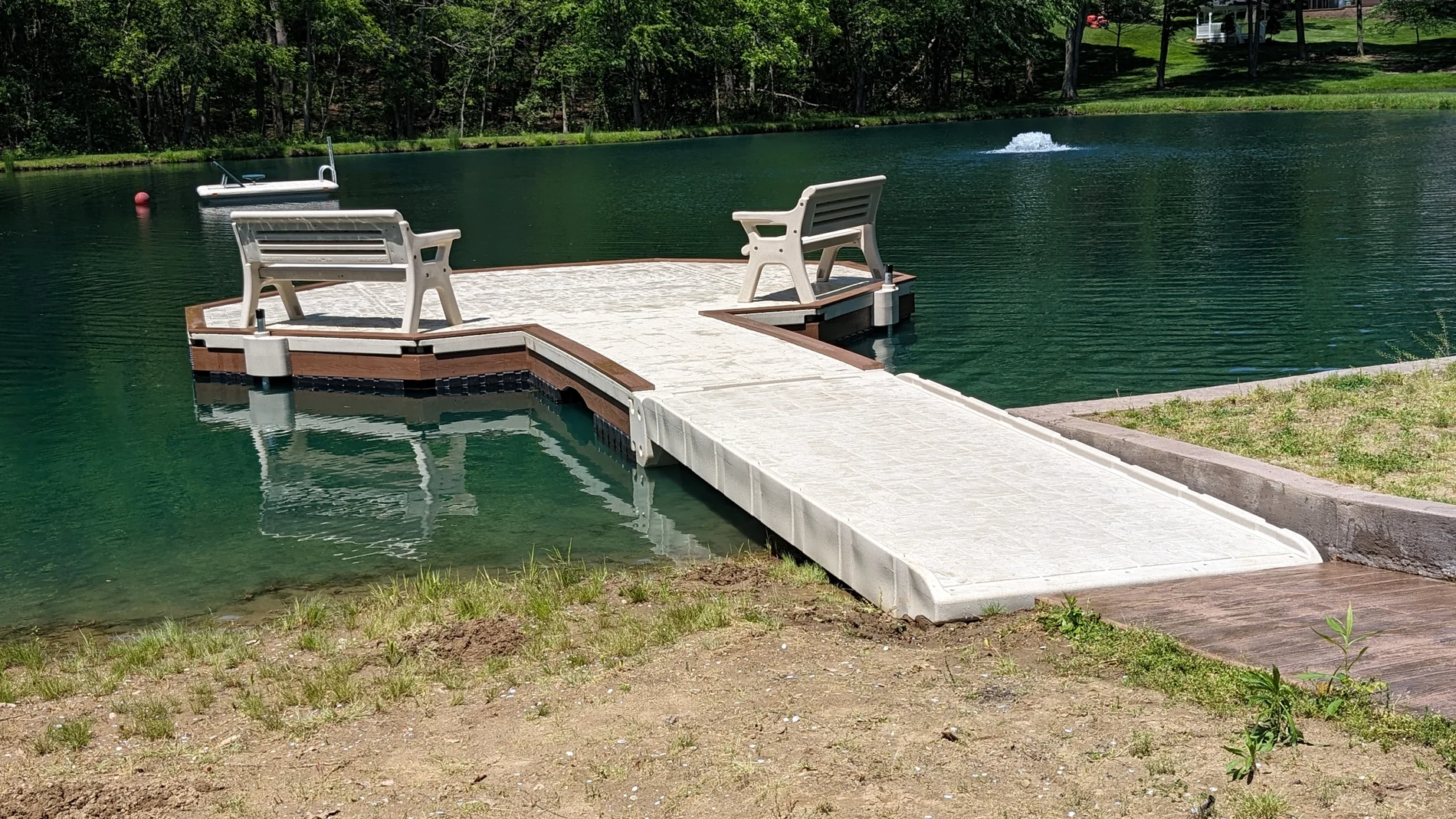
At the Canal Fulton Private Pond Retreat, AquaLife combined a custom WEARDECK and Wave Armor floating dock with two benches and a separate swim raft. The project photos show the shore approach, seating and the relationship between the two platforms.
Use the project to identify features you like, then assess them against your own pond. Its layout is not a standard plan for every bank or water depth.
Review custom additions as part of the system
Custom decking, benches and edging can change loads and connections. A combined design needs a deliberate structure and compatibility review; it should not be treated as permission to attach any board or accessory to a factory section.
Ask the proposal to identify the components and how they work together. Include a way to reach connection hardware for inspection and future service.
Plan ownership before installation
Discuss cleaning, inspections, winter handling and any separately quoted service. Choose the final footprint with both everyday use and seasonal work in mind.
A useful starting brief
- Photos of the bank and the pond from several angles.
- Approximate depth where the dock and raft might sit.
- Known seasonal water changes and construction access.
- Expected activities, seating needs and the number of users to plan for.