
Boats & PWC · 3 MIN READ
Choosing and Installing a Jet Ski Port
By AquaLife Construction · Updated
A good PWC port choice considers the craft and the installation together. The hull must match the support arrangement, the approach must work with the available space, and the attachment must suit the dock or seawall. Start there before comparing accessories.
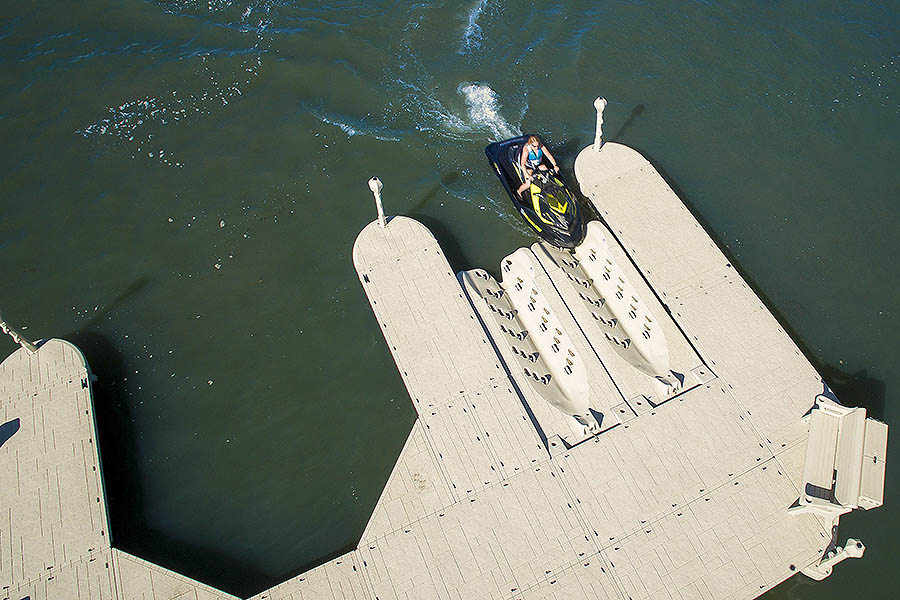
Match the craft first
Provide the PWC model, year and loaded weight with fuel and equipment. Hull shape and the placement of support rollers matter alongside rated capacity. A larger port is not necessarily compatible with a particular hull.
If you expect to change PWCs, share the prospective model as well. Have both assessed rather than buying extra length or capacity and assuming the future craft will fit.
Check the approach and attachment
- Approach: identify a clear route onto the port without an awkward turn beside another boat.
- Depth: check the available water at the entry end, including seasonal low levels.
- Structure: identify whether the port connects to a floating dock, fixed dock or seawall.
- Movement: select the approved attachment for the structure and water-level range.
- Walking space: leave a usable route for stepping off, securing the craft and reaching the dock.
Wave Armor or EZ Dock: compare the actual ports
AquaLife supplies Wave Armor. That experience is useful for planning its installations, but it does not make every competing product unsuitable. Compare named models with the same PWC and a complete installation scope.
Swipe the table to compare all columns.
| Ask about | Why it matters |
|---|---|
| Hull support and adjustment | The craft must contact the intended support points. |
| Attachment kit | The port must connect appropriately to your structure. |
| Entry and exit | Loading effort depends on craft, setup and conditions. |
| Walking area | Check the space remaining with the PWC parked. |
| Service and seasonal work | Compare replacement parts, inspection and winter handling. |
Where product features fit into the decision
For a compact model such as the Wave Armor Pro 5, review the usable footprint and hull support with the current instructions. Adjustable roller locations are a setup feature, not permission to move rollers without checking the specified arrangement.
Compare the SLX and Pro options around the actual installation. Do not infer suitability for rougher water from a series name. Canopies and side extensions also need their own compatibility, flotation and attachment review.
If the PWC becomes difficult to load
Pause and identify what changed: the craft, roller condition, alignment, attachment movement, depth or weather. Do not compensate for a persistent problem by using more throttle. Follow both the PWC and port instructions, including engine-cooling requirements and operating limits.
A correctly fitted port still has limits. When wind or waves make loading unsuitable, use the equipment’s recommended alternative procedure rather than treating successful loading on a calm day as proof for all conditions.
Make inspection easy
Keep access to rollers and attachment hardware clear. Ask which checks you can perform, which adjustments need service and what seasonal removal involves. Recheck the setup whenever the craft, accessories or dock arrangement changes.
Send these details for a recommendation
- PWC make, model, year and loaded weight information.
- A wide photo of the dock and close views of the proposed connection.
- Photos showing the approach and nearby obstructions.
- Known water depth, level changes and your location.